 3 / S C
A good number of people showed interest on our previous post about how an anti-solution, Socratic AI framework is a better model to cultivate critical thinking in students and learners than general-purpose AI.
As I was chatting with @Kenneth, he told me about Hermes, an AI tool that only provides editorial guidance, while strictly staying away from producing the write-up. It enters at the editorial stage of the writing process only.
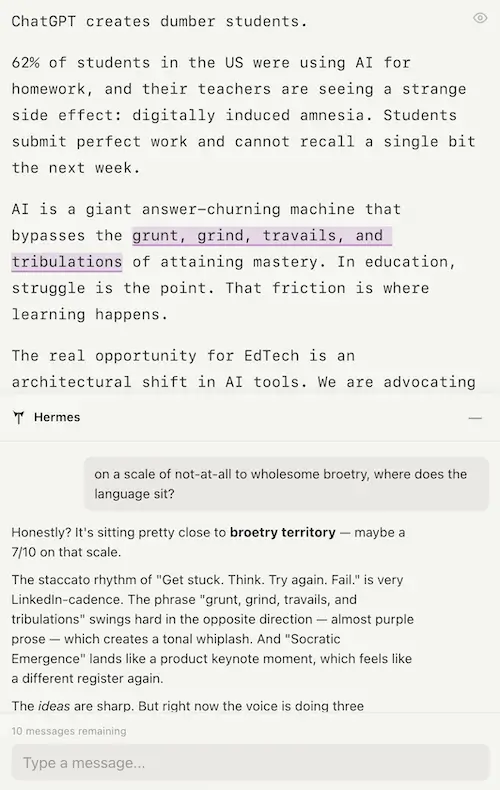 Hermes helping me get over my broetry
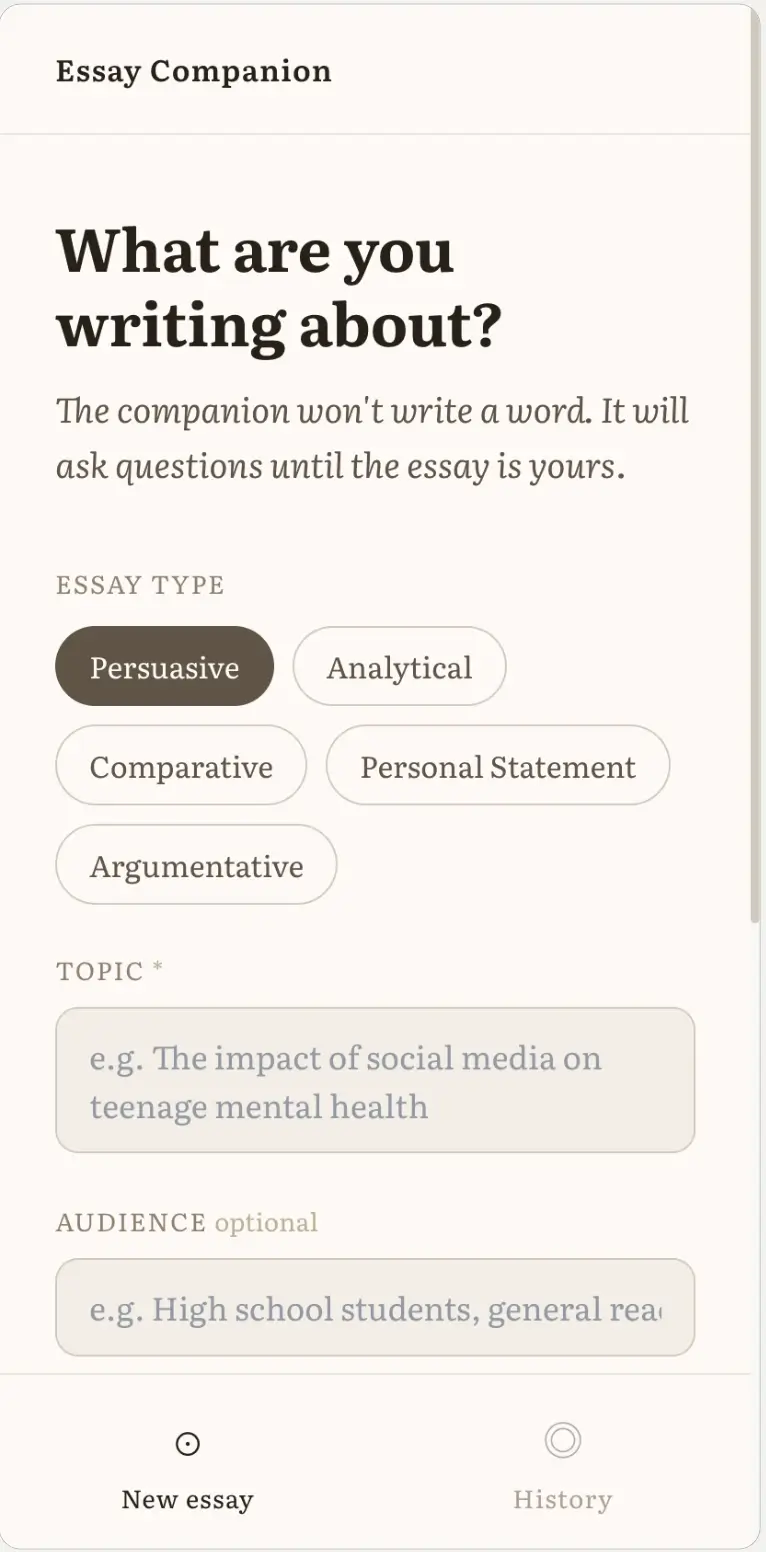
The Socratic Essay Companion is meant to help write from a blank slate while sitting in the same philosophical lane as Hermes. It does not write for you: it poses questions, the answers to which build the essay, becoming a thinking partner.
The Socratic Essay Companion
When a student begins a conversation with the Essay Companion, they provide context such as topic, audience, and position. The AI does not respond with a long-form essay; it asks a question that demands that the learner examine their own understanding. It elicits the essay by asking the right questions. This is the same architecture we saw in the last post.
The mechanics remain the same, while some structures underneath change:
- There is no right answer. As opposed to the Socratic Tutor, the Essay Companion does not have a right answer, because that is the nature of essays. The core constraint is now not to guard an answer but not to overreach and put words that did not come from the learner.
- The output belongs to the learner. In the Socratic Tutor mode, the AI had an outline, and the student reached a pre-existing answer. In the Essay Companion, what emerged belongs to the student.
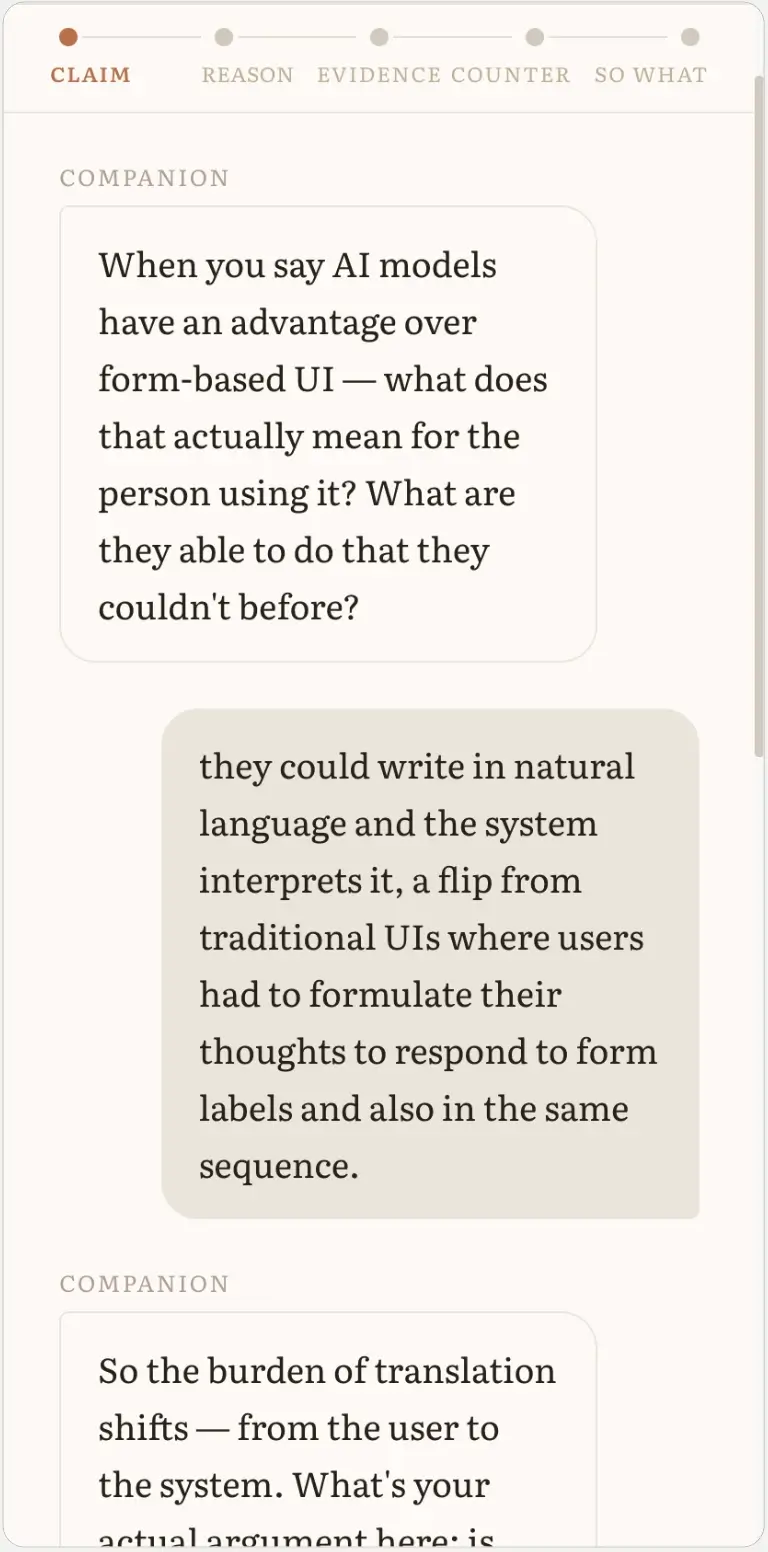
Write to us to get access to the Socratic Essay Companion working prototype.
The “Stuck” Position
When a learner is confused and cannot proceed further, that “stuck” position is hard to diagnose. In the Tutor mode, “stuck” means the problem is unclear. In the Essay Companion mode, the user may face two roadblocks: “I can’t articulate” and “I haven’t thought about it.” The AI cannot detect this confusion on its own without an explicit signal from the user. This is where our old trusty [Give me a Hint] comes to the rescue.
When the user invokes Hint, they get a diagnostic question that helps the AI understand whether they have an articulation problem or they haven’t formed a position. The AI then performs an internal triage: if the student has been on a path related to the topic so far, it tries to extract that position. In case of a blank slate, it asks provocative questions to help find a position and slant.
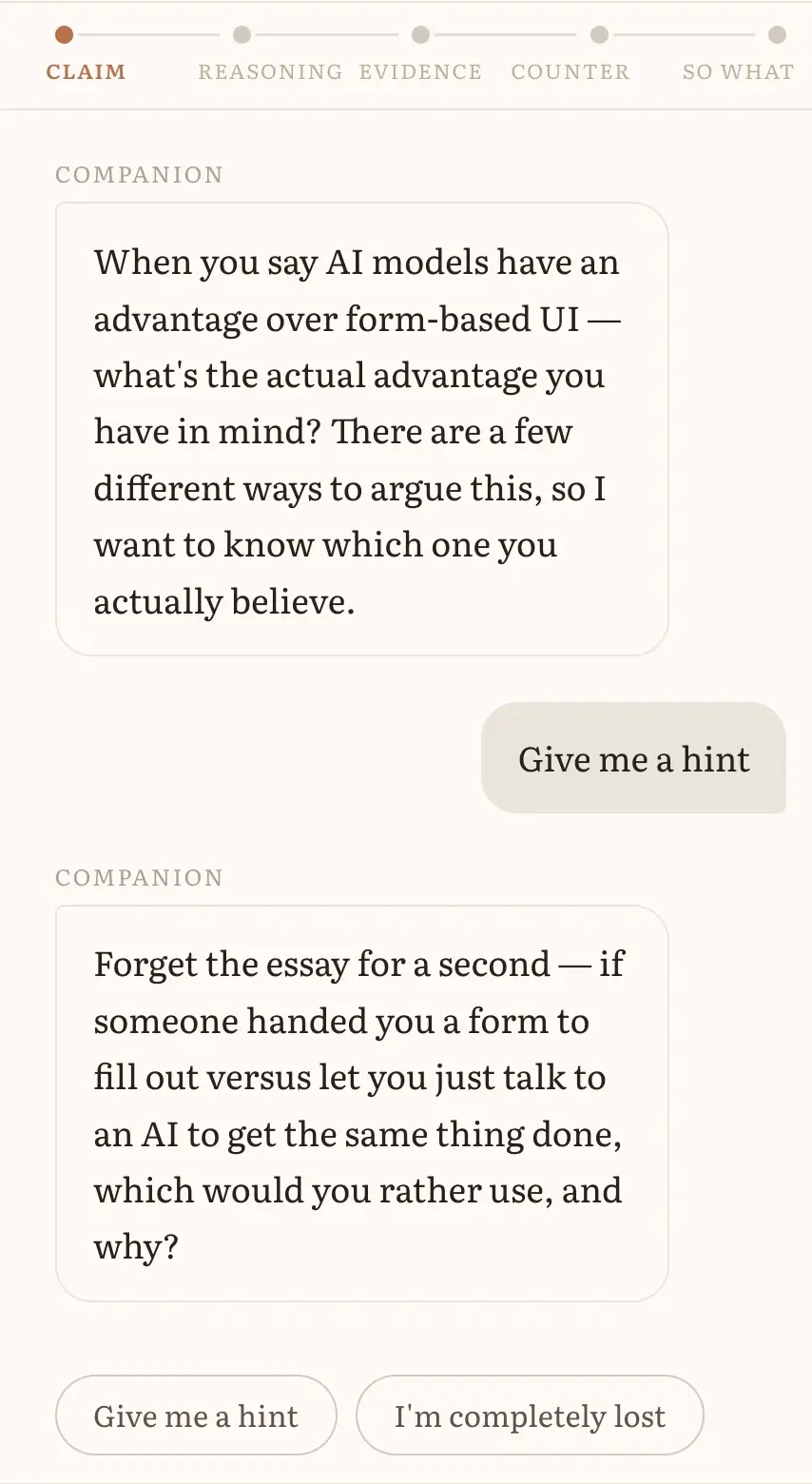 Hint probes the users with a question to understand whether confusion is lack of articulation or a lack of position
Essay conclusions, on the other hand, are open-ended by design. As there is no definite target answer, the AI cannot decide if the student has arrived. It reads whether a position is fully developed, not whether it is correct.
Closing thoughts
As I debate these patterns with Claude, it suggested that these strategic ideas fall into an under-developed category of AI products: AI-exposed, where AI is the interface and the product leverages AI’s behaviour, to build new interaction patterns that define the product’s strategic direction. The Socratic Emergence Essay Companion is not just a better pedagogical tool. Instead of using the AI model to create output, it uses the model’s behaviour to ask questions and perform triages. This is a distinction worth building on.
disclaimer: The Socratic Emergence and The Friday Problem were both formed in deep consultation with Claude. No amount of humanization succeeded in reducing the traces and tone of AI afterwards. The current article was written entirely by human, warts and all, with AI only creating an outline and purely as a sparring buddy.
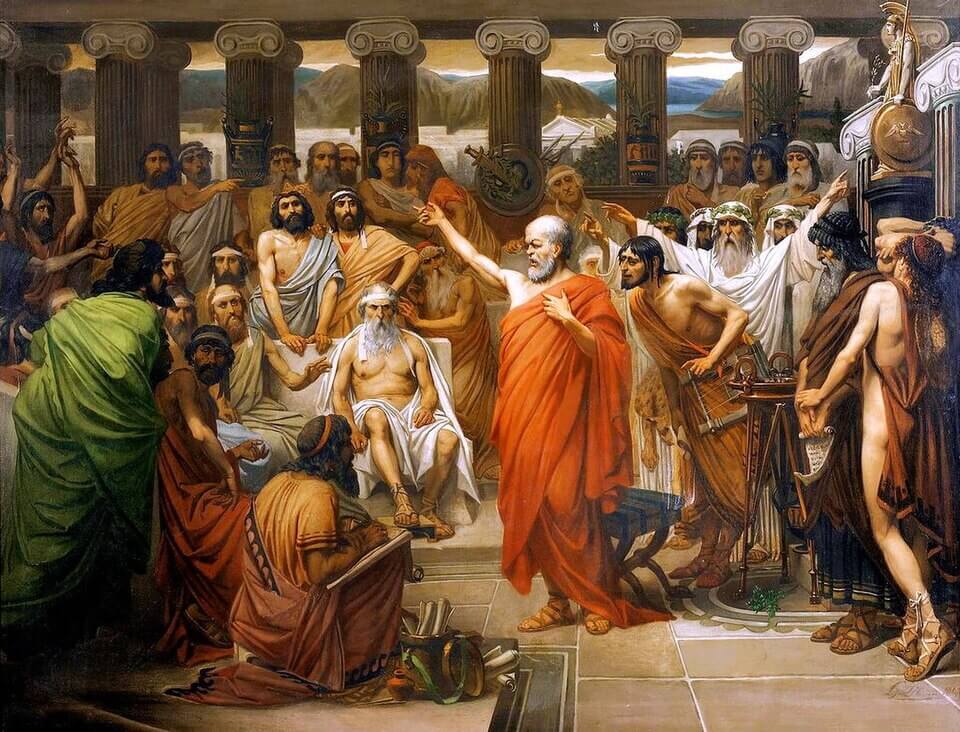
Cover image: Louis Le Brun, Public domain, via Wikimedia Commons