 3 / S C
As the previous post demonstrated, Orion’s core focus was limited to get people from a vague intent to a confirmed decision. Once a ticket was booked, Orion’s job would be over.
Purchase is an incorrect end-point for a concierge because a purchase isn’t an experience, merely commitment to one. Everything that happens from the point of booking to the actual experience and after the experience is invisible to the system. A lot of rich signals lie within those. In ending the journey at booking, it loses out on building a relationship with you across lifecycle.
Take an example: you booked tickets for a group of 5 for a Gorillaz concert at Wankhede Stadium, Mumbai two weeks from now. All done as recommended by Orion.
AI concierge enters the chat
Orion has a memory and a judgement, derived from your own relationship with the concierge. Orion knows all the context of this booking: the timings and the location; group-size; whether the event is outdoor or indoor; what to expect in terms of energy, and your entire Taste Profile (see: The Friday Evening Problem). It already knows your status at the end of the event. While most products apply data-triggered proactive nudges—a price drops, a timer fires, a threshold is crossed—Orion’s re-entry is context-triggered because it knows what you just experienced, not just that a moment has elapsed.
This is not an inference from a cold start; it is knowledge accumulated over a relationship, and that is what Orion brings when the event ends before you even opened the app.
A food-ordering or table-booking app starting at 11pm DOES NOT HAVE any of this knowledge because it starts each session at zero and has no way of knowing more. It is structurally disadvantaged when compared with an AI concierge like Orion. At the same time, Orion’s behaviour is consistent with the ground reality of restaurants: if you walked into a restaurant at that time, the staff would be able to read all those signals right away.
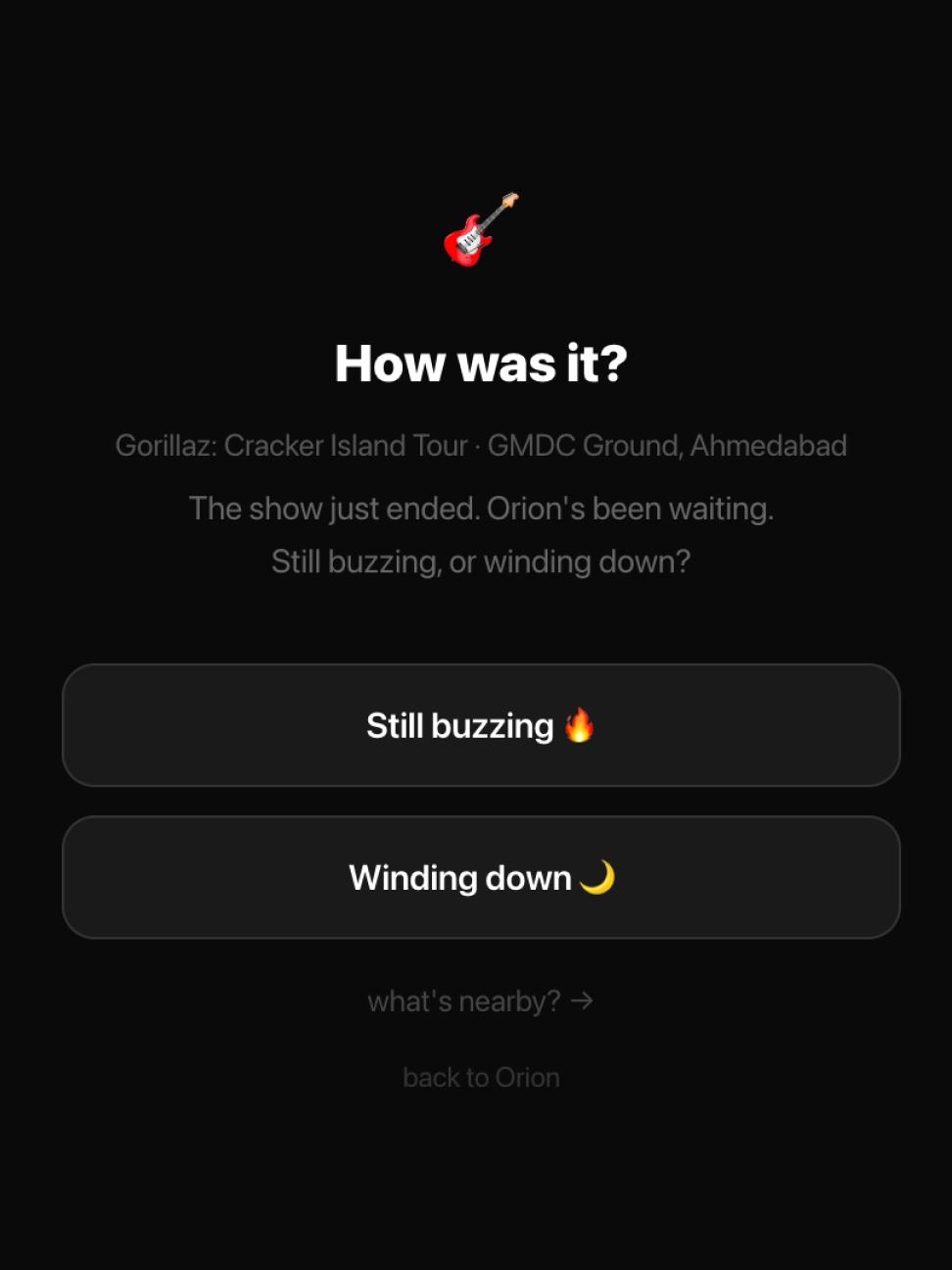
What matters is not only the timing of the question; it is what Orion already holds when it asks. As the event ends, Orion pops a small nudge to get your feedback: How was it?
This question does two things:
- First, it captures your state whether you are winding down or still roaring for more.
- Second, you responding to this question tells Orion that you are open to ideas.
Even skipping the question and asking something else is signal enough.
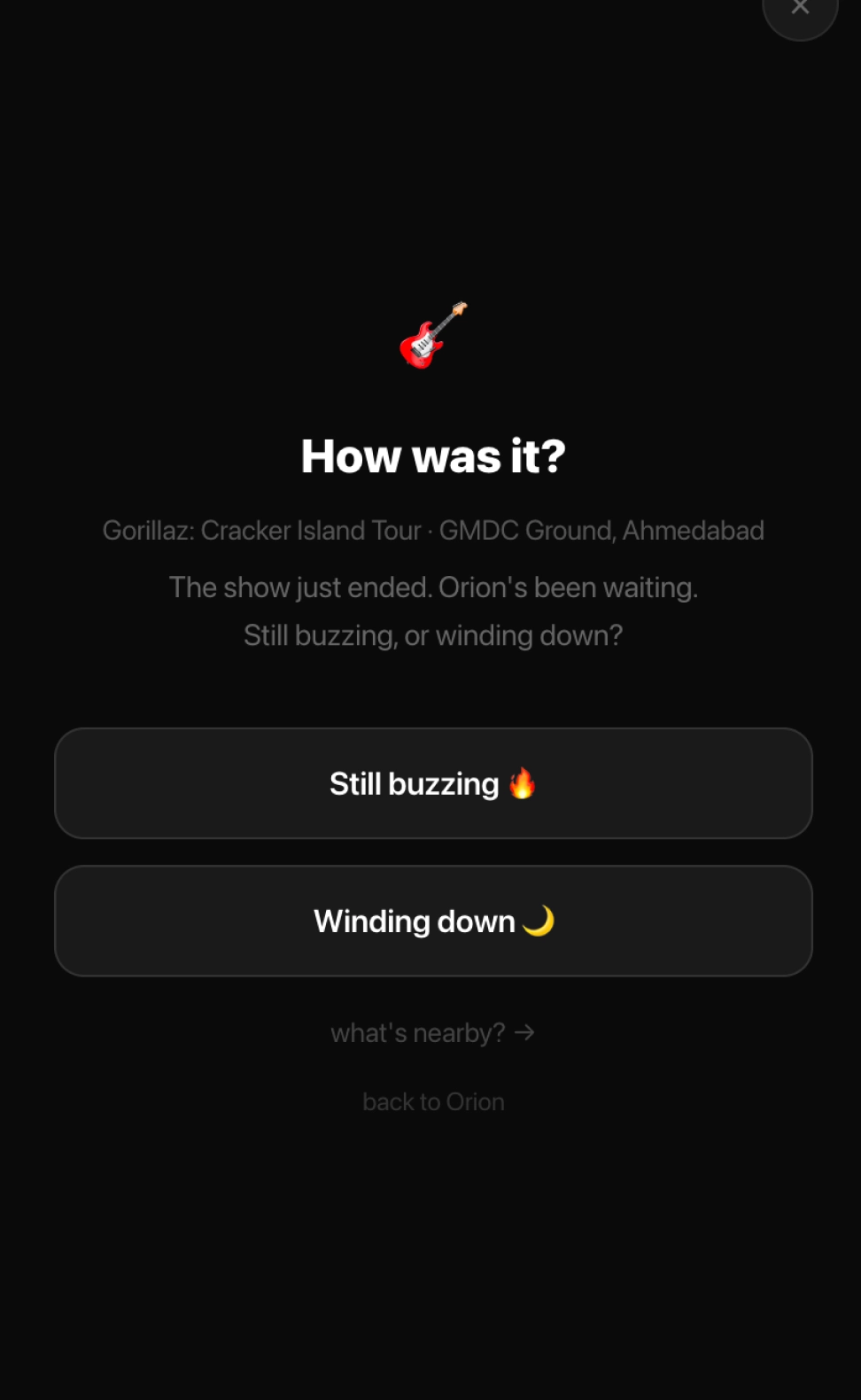 Orion makes a post-event reentry with simple nudge that does heavy-lifting at two levels.
Write in to access our vibe-coded working prototype.
Post-event mechanism
At full capacity, Orion’s recommendation engine surfaces three cards:
an Anchor, the most confident pick; a Breadth, popular or most booked; and a Contrast, to expand the number of choices.
The post-event journey has the same underlying architecture. But during this journey, only the Anchor card surfaces by default. Orion assumes low decision-making energy and shows its most confident suggestion. This respects your cognitive load after an exhilarating 3-hour long Gorillaz concert by deliberately offering less.
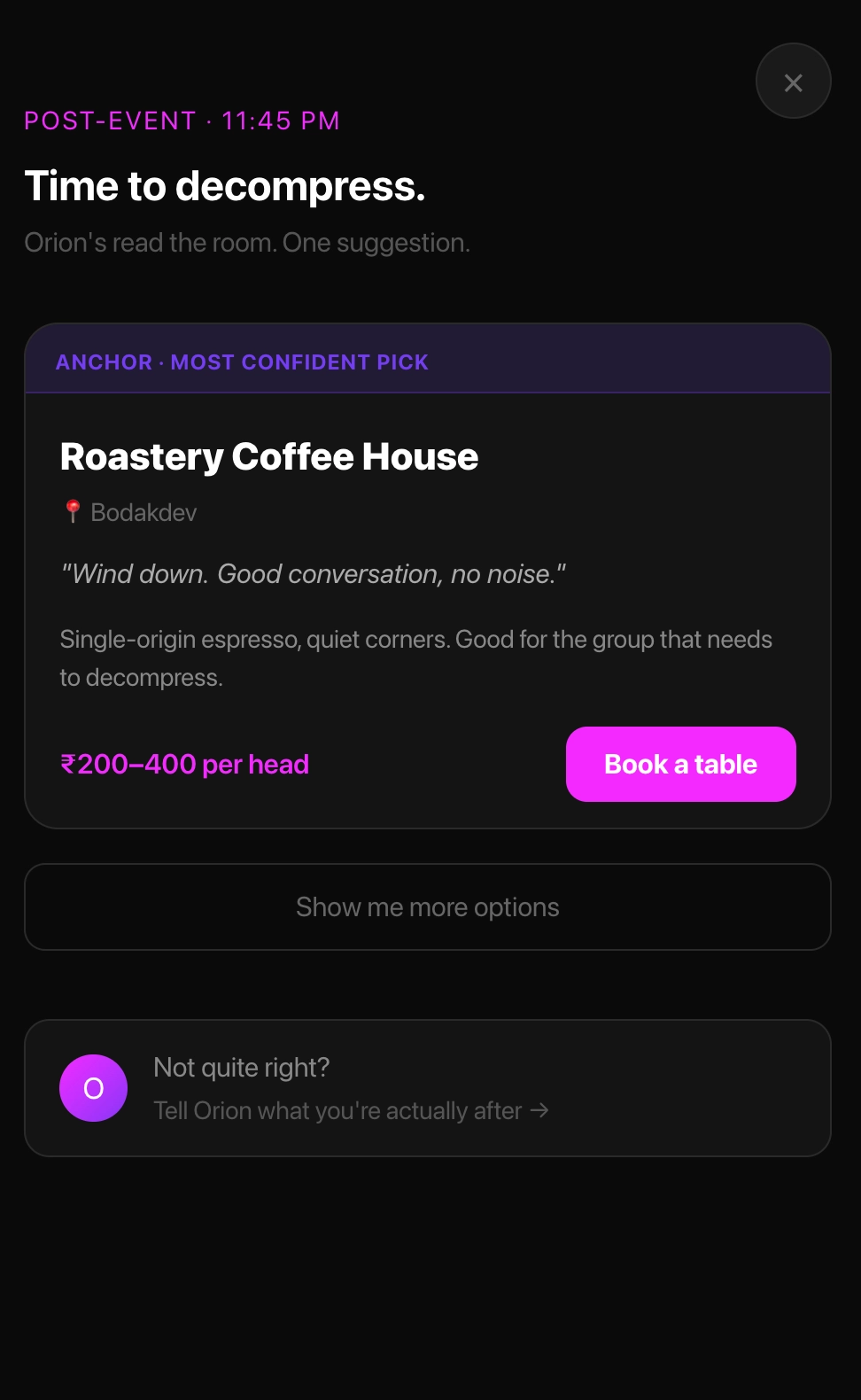 the post-event recommendation journey is designed to work with possibly low cognitive load capacity in that moment
The other two cards: Breadth and Contrast are handy for you to explore, retaining an architectural consistency of the recommendation engine, but they aren’t at the fore.
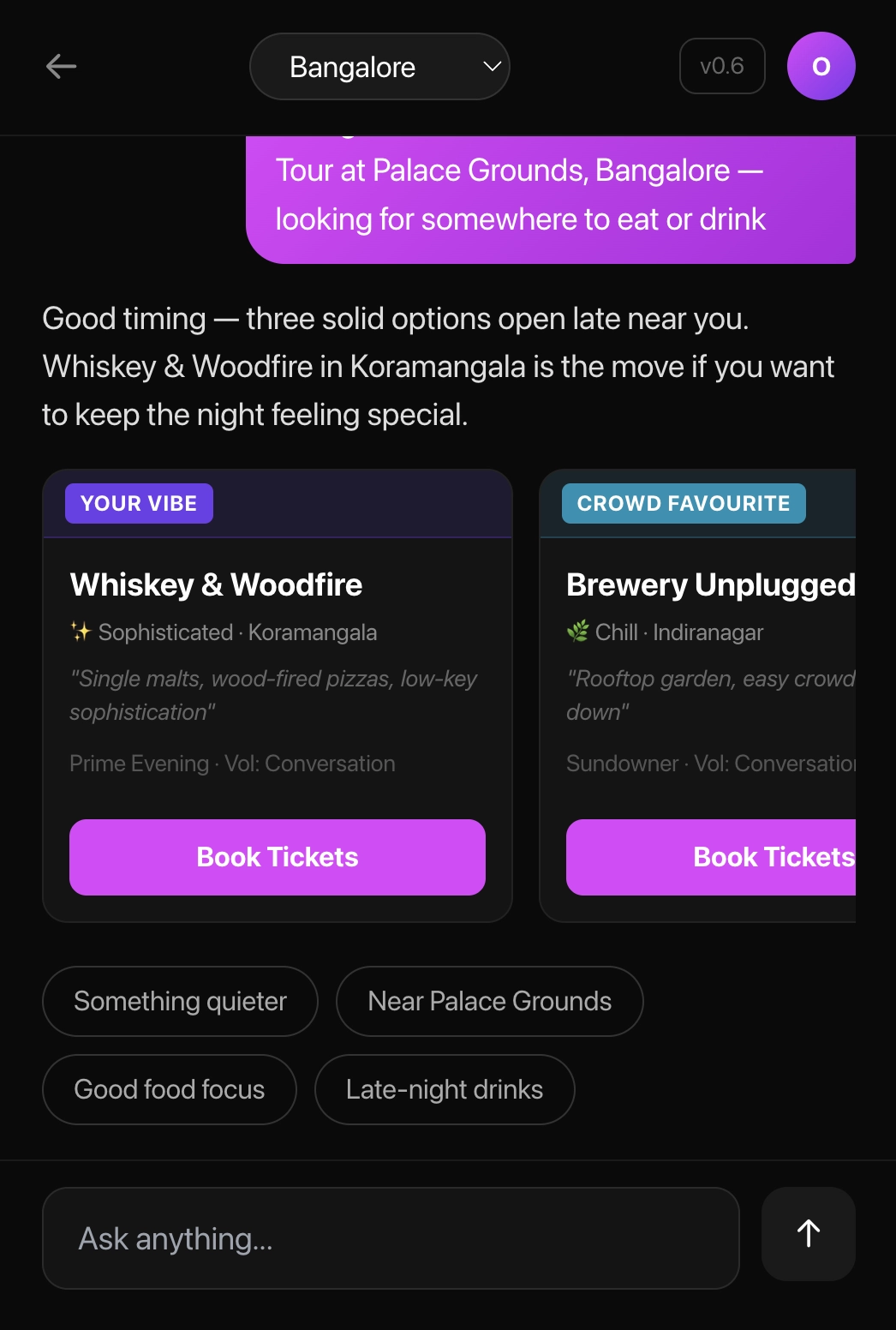 if you feel energized enough to explore further, orion makes it easy to start a new conversation
Autonomy
By design, Orion has an autonomy gradient:
- Recommend: when you are a new user, it will make recommendation when you ask it to.
- Surface: Orion proactively makes recommendations without being asked. It knows your patterns well enough to reach out.
- Hold: Orion acts. When it has surfaced things accurately enough, consistently enough, it has earned your trust and it moves to the next step. It now provisionally holds something for you. The final commitment is still with you.
It is built on the principle of Progressive Trust, where both the actors - you and Orion - learn about each other over time and hance bigger decisions, more autonomy is granted to the concierge.
In the Gorillaz example: the first time, Orion suggests a late-night spot that you would book yourself. A few events later, it knows your post-show pattern well enough to reach out before you ask. Further still, it holds a table at the right place while you’re still taking post-gig pictures with your friends.
The autonomy gradient is more about demonstrated accuracy than elapsed time, and the trust that follows from it. Each upstream step pre-requires that the previous one was validated by your behaviour.
Taste Profile: unleashed
The post-event behaviour provides signals that would otherwise get lost if the concierge only helped you up to a booking. This extension allows those signals to be captured, and enriches the taste profile. Orion’s Taste Profile model is built from what you do, not only what you say, with behavioural signals from every session, compounding over time.
Coming back to Orion post-event also means that you enjoyed the recommended concert, and the journey after that. The profile calibrates and becomes sharper instead of plateauing. A pre-event signal tells Orion what you were willing to try. A post-event signal tells it whether its judgment was right and how well the recommendation held up.
This pattern compounds over bookings, establishing a deeper trust. That trust gives Orion more autonomy and unlocks the agentic behaviours described earlier. It now moves into real concierge territory, beyond being a smart booking helper.
Where this fits right in, and where this could be extended
Orion, as an agent, assumes that it has cross-vertical integrations. Considering that:
Food + Event e-commerce
For multi-domain organizations such as District+Zomato or Scenes+Swiggy, an Orion agentic concierge workflow fits right into their existing product logics. It allows them to build something they currently don’t have: a true cross-domain Taste Profile across different axis.
Ed-tech
Extending an ed-tech product, an AI agentic platform can create dynamic personalized learning pathways, over a complete learning lifecycle, as opposed to the linear, pre-built pathways most products offer. At the same time, it could capture signals like time spent on modules and drop-off points. This is where Orion’s agentic logic meets Socratic’s, the former builds the long-term journey while the latter deepens the experience.
Closing thoughts
Orion, Socratic Tutor, and Essay Companion are attempts at reimagining existing experiences and making them deeper using AI. It is a territory still being charted, but I hope it gets more attention and sooner.
Our detailed framework document on the design approach behind Orion is available on request.